‘부엔 까미노’(Buen Camino)라고 인사하는 순례자의 대열에 들어갈만큼 신심이 깊지도 못한 사람이, 많은 사람의 버킷리스트인 산티아고 가는 길을 어쩌다가 걷게 되었습니다. 인생길이 그러하듯이 이번 여행길도 전혀 제 의지와는 상관없이 인도되었습니다. 1월 미국을 방문했을 때, 요즘 ‘뜨거운 감자’인 <아시아나 마일리지>가 꽤 된다는 사실을 알고, 시카고 휄로우십 교회 담임 심창섭 목사님께서 느닷없이 마일리지를 활용한 여행을 먼저 제안해서 시작된 일입니다. ‘어디가고 싶으세요?’ ‘유럽이지요^^’ 그래서 한 번도 꿈꾸지 못한 마일리지를 활용한 해외여행건이 시작된 것입니다. 게다가 이번 여행이 결혼50주년 선물로 하나님이주신 것이라는 것을 깨달을 수 있을만큼 예기치 못한 재정적인 후원도 받았으니 말입니다.
그래서 4월 1일 로마로 들어가서 26일 바르셀로나로 나오는 이태리-스페인 여정이 만들어졌습니다. 그 가운데 4월 15일(화) 사리아에서 출발해서 21일(월) 산티아고 데 콤포스텔라에 도착하는 7일간의 산티아고 길을 걷게 되었습니다. 그러나 짐을 지고 일주일을 걷는다는 것은 치밀한 공부가 필요한 일입니다. 무엇보다 짐을 줄이는 것이 큰 과제였습니다. 두 주간 이태리에 머물면서 이리 저리 생각해 보니, 마드리드에서 여행용 캐리어 두 개를 하나는 바르셀로나로, 다른 하나는 산티아고로 보내는 것이 최선의 방안처럼 보였습니다. 쳇지피티에게 물었더니 우체국을 통해서, 별도 포장 없이 캐리어를 보낼 수 있다는 답을 얻었습니다. 마드리드 공항에 나온 67학번 입학동기 김대영 선교사 님과 우체국에 갔습니다. 갔더니, 평소에 붐비던 우체국이 주말부터 연휴라 모두 떠나고, 월요일에는 늘 북적이던 우체국이 한산해서 기다릴 필요가 없이 순적히 캐리어 두 개를 보냈습니다.
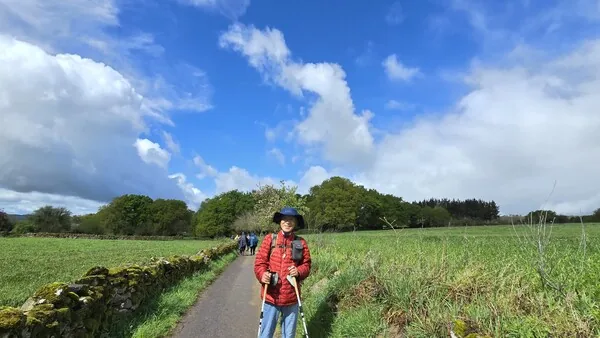
덕분에 두 사람이 각기 자기 체중에 맞는 무게의 배낭을 지고 길을 떠났습니다. 보통은 하루에 25킬로 정도를 걷는 것이 상식이지만 우리는 처음부터 아예 12킬로 정도 걷기로 마음을 먹었습니다. 그러면 왼 종일 걷지 않고 한나절만 걷고 점심 때쯤 다음 목적지에 도착하게 됩니다. 하지만 그 거리도 처음에는 쉽지 않았습니다. 그동안 등산팀 519부대와 함께 거의 매주 토요일이면 북한산을 대여섯 시간씩 걷곤 했지만 무거운 배낭을 지고 걷는다는 것은 또 다른 문제라는 것을 첫 날 길을 나서자 말자 깨닫게 되었습니다.게다가 비는 시도 때도 없이 내리고, 때로는 바람이, 때로는 우박이 쏟아지고 눈까지 내렸으니, 처음 이틀은 걷는 것을 포기하고 싶은 생각조차 들었습니다. 하지만 앞에서 뚜벅뚜벅 걷는 아내가 부럽기도 하고 신기하기도 했습니다.
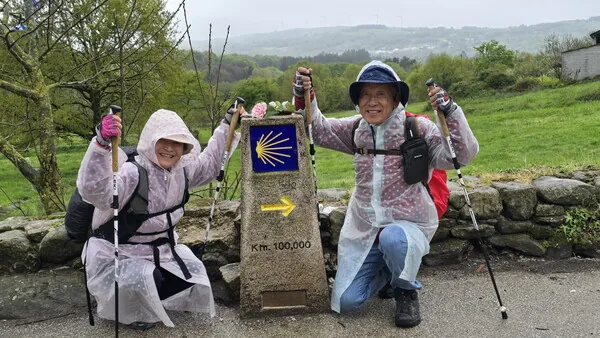
그래도 하루를 걷고 나서는 비오는 날씨를 대비한 배낭 덮개도 사서 쒸우니, 심리적으로 위로가 되었습니다. 사흘째부터는 스틱과 걸음이, 또 배낭과 등허리가 서로 친해져서 서로에게 더이상 짐이 되지 않았습니다. 게다가 걷는 속도도 조금씩 나기 시작했습니다. 대개 숙소에 도착할 즈음에는, 점심을 사서 먹었지만, 대부분의 숙소가 아침이 포함되어 있지 않으니, 그 동네 가게를 찾아가서, 저녁과 아침을 먹을 것을 구입하고, 숙소에 도착하면 샤워를 하는 것만큼이나, 젖은 옷가지를 말리는 일이 주 업무로서 맨 먼저 자리했습니다. 하필 그 기간은 고난주간이었으니 딱히 불평할 이유도 없었지만 수난 금요일은, 종일 비옷을 벗지 못하고, 평소보다 늘어난 거리, 15킬로를 걷는 수난의 하루였습니다.
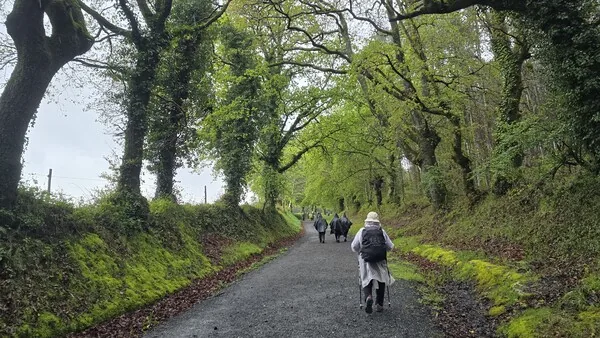
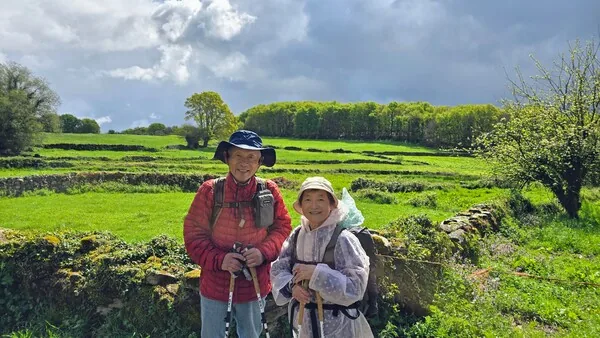
스치는 사람들과는 입으로 ‘부엔 까미노’(Buen Camino)를 건네지만, 마음 속으로는, 내가 만든 신조어인 ‘부엔 나뚜라’(Buen Natura)를 읊조리고 있었습니다. 참으로 내가 살던 곳과는 다른 아름다운 자연이 길목마다 펼쳐지는 시간이었습니다. 비가 내리는 날씨도, 길가에 피어있는 풀과 꽃들도 아름다웠고, 계속 만나는 들판과 숲속의 초목도, 창조주 하나님의 솜씨를 찬양할 수 밖에 없었습니다. 길을 걷는 중간에는 생리적인 볼일을 보기 위해서라도 카페를 들릴 수 밖에 없었습니다. 비록 이름은 이태리에서는 까페마키아또라고 하고 스페인에서는 까페꼴따도라고 불렀지만, 커피는 어디든 아주 싼 값에 마실 수 있었으니 감사했습니다. 게다가 내가 좋아하는 크로와상은 어디든 가장 쉽게 만나는 빵이었고, 날마다 걷는다는 명분으로 먹을 수 있으니, 비바람 속을 걷는 고난 중에도 감사가 자리한 여정이었습니다.(구주대망 2025년 4월 15~21일, 산티아고 길에서)
Though not possessing faith deep enough to naturally fit into the ranks of pilgrims who greet one another with “Buen Camino,” I somehow found myself walking the Camino de Santiago—a journey that is on so many people’s bucket list. Just as life often unfolds, this journey was guided entirely beyond my own will. While visiting the United States in January, I realized that I had accumulated quite a substantial amount of Asiana airline miles—a topic much discussed these days. Out of nowhere, Pastor Chang-Seop Shim of Chicago Fellowship Church first suggested using those miles for a trip, and that was how it all began. “Where would you like to go?” “Europe, of course! ^^” And so began an overseas trip utilizing frequent flyer miles that I had never even dreamed of. Moreover, we received unexpected financial support, allowing us to recognize that this journey was truly a gift from God for our 50th wedding anniversary.
Thus, an Italy-Spain itinerary was crafted: entering via Rome on April 1st and departing from Barcelona on the 26th. Right in the middle of it, we were to walk the Camino de Santiago for seven days, setting out from Sarria on Tuesday, April 15th, and arriving at Santiago de Compostela on Monday, April 21st. However, walking for a week carrying all one's belongings requires meticulous preparation. Above all, reducing our luggage was our biggest challenge. After pondering over this back and forth during our two-week stay in Italy, the best solution seemed to be forwarding our two travel suitcases from Madrid—sending one to Barcelona and the other to Santiago. When I asked ChatGPT, it replied that suitcases could be shipped via the post office without any additional packaging. Accompanied by Missionary Dae-Young Kim, my college classmate from the Class of '67 who met us at Madrid Airport, I visited the post office. When we arrived, the post office—usually crowded—was nearly deserted because everyone had left for the holiday weekend. Thus, on a Monday morning that would typically be bustling, it was empty, and without waiting at all, we smoothly shipped both suitcases.
Thanks to that, the two of us were able to set out on the road carrying backpacks fitted to our respective body weights. While it is common practice to walk around 25 kilometers a day, from the very beginning we resolved to walk only about 12 kilometers daily. That way, rather than walking the entire day, we would walk for just half a day and reach our next destination around lunchtime. Even that distance, however, was not easy at first. Although I had been hiking Bukhansan Mountain for five to six hours almost every Saturday with our “Unit 519” hiking group, the moment we stepped onto the trail on the first day, I realized that walking with a heavy backpack is an entirely different matter. On top of that, rain fell incessantly, alternating with gusts of wind, pelting hail, and even snow, so that during the first two days I genuinely contemplated giving up. Yet watching my wife walk steadily ahead with firm strides, I felt both admiration and amazement.
Still, after completing the first day, we bought rain covers for our backpacks to prepare for wet weather, which provided great psychological comfort. By the third day, the walking sticks and our stride, as well as the backpacks and our lower backs, had become well acquainted, no longer feeling like an unbearable burden to one another. Furthermore, our walking pace gradually began to pick up. Usually, around the time we reached our lodging, we would buy lunch to eat; however, since most accommodations did not include breakfast, we would head to the local village shop to purchase items for dinner and the next morning’s breakfast. Upon arriving at each accommodation, drying our soaked garments took priority as our most urgent task, right alongside taking a warm shower. Since that week happened to be Holy Week, there was no real reason to complain, but Good Friday turned out to be a true day of passion: we could not take off our raincoats the entire day, trudging through an extended distance of 15 kilometers.
With our lips, we exchanged the greeting “Buen Camino” with passersby, but in my heart, I kept murmuring a word I coined: “Buen Natura.” It was truly a time when beautiful nature, so distinct from where I lived, unfolded at every turn of the road. Even in the rainy weather, the grass and wildflowers blooming along the wayside were breathtaking, and the endless fields and forest greenery compelled me to praise the wondrous craftsmanship of God the Creator. Along the way, we inevitably stopped by local cafés, if only to attend to nature's call. Although the coffee was called caffè macchiato in Italy and café cortado in Spain, it was a blessing that we could enjoy good coffee anywhere at a very affordable price. What is more, croissants—my favorite pastry—were readily available everywhere, and being able to indulge in them each day under the justification of walking made this journey one filled with thanksgiving, even amid the trials of walking through wind and rain. (In anticipation of our Lord's return, April 15–21, 2025, on the Camino de Santiago)
Alhoewel ek nie oor ’n geloof beskik wat diep genoeg is om my sommer tuis te laat voel tussen die rye pelgrims wat mekaar met “Buen Camino” groet nie, het ek op die een of ander manier tog beland op die pad na Santiago—’n reis wat op so baie mense se wenslys verskyn. Soos dit dikwels met die lewenspad gaan, is hierdie reis geheel en al buite my eie wil gelei. Toe ek in Januarie besoek aan die Verenigde State afgelê het, het ek agtergekom dat ek heelwat Asiana-lugmyl opgebou het—’n warm patat deesdae. Heeltemal onverwags het leraar Chang-Seop Shim van Chicago Fellowship Gemeente voorgestel dat ons ’n reis onderneem deur daardie myle te benut, en dit was hoe alles begin het. “Waarheen wil u graag gaan?” “Europa natuurlik! ^^” En so het ’n oorsese reis met lugmyle waarvan ek nooit eers kon droom nie, werklikheid geword. Boonop het ons sulke onverwagte finansiële ondersteuning ontvang dat ons duidelik kon besef dat hierdie reis ’n geskenk uit God se hand was vir ons 50ste huweliksherdenking.
So is ’n reisplan deur Italië en Spanje saamgestel: ons het op 1 April in Rome aangekom en op die 26ste vanaf Barcelona vertrek. Te midde daarvan sou ons sewe dae lank die Camino de Santiago stap—met vertrek vanaf Sarria op Dinsdag 15 April en aankoms in Santiago de Compostela op Maandag 21 April. Om egter ’n hele week lank met jou eie bagasie op jou rug te stap, vereis deeglike beplanning. Bowenal was die vermindering van ons bagasie ’n reuse-uitdaging. Nadat ek tydens ons twee weke lange verblyf in Italië lank daaroor nagedink het, het dit gelyk of die beste plan sou wees om ons twee groot reistrollies vanaf Madrid te versend—een na Barcelona en die ander na Santiago. Toe ek ChatGPT vra, het dit geantwoord dat ’n mens reistrollies via die poskantoor kan stuur sonder enige ekstra verpakking. Saam met sendingwerker Dae-Young Kim, ’n universiteitsmaat uit die klas van '67 wat ons op die Madrid-lughawe ontmoet het, is ek na die poskantoor toe. By ons aankoms was die poskantoor—wat gewoonlik stampvol is—heeltemal stil omdat almal reeds vir die langnaweek vertrek het; en so kon ons op ’n Maandag, sonder om enigsins te wag, albei trollies vlot versend.
Danksy dit kon ons twee die pad aandurf met rugsakke wat presies by ons eie liggaamsgewig pas. Gewoonlik is dit die gebruik om sowat 25 kilometer per dag te stap, maar ons het van die begin af besluit om net sowat 12 kilometer per dag aan te pak. Op dié manier sou ons nie die hele dag aaneen stap nie, maar net ’n halwe dag, en teen etensuur by die volgende bestemming aankom. Maar selfs daardie afstand was aanvanklik glad nie maklik nie. Alhoewel ek voorheen byna elke Saterdag vyf tot ses uur lank saam met ons staptogspan, Eenheid 519, op Bukhansan-berg gestap het, het ek reeds op die heel eerste dag besef dat dit ’n gans ander saak is om met ’n swaar rugsak te stap. Boonop het die reën sonder ophou geval, soms vergesel van wind, soms van haelbuie en selfs sneeu, sodat ek gedurende die eerste twee dae werklik daaraan gedink het om tou op te gooi. Tog was dit vir my wonderlik en bemoedigend om te sien hoe my vrou met vaste, doelgerigte treë voor my uit stap.
Nadat ons die eerste dag voltooi het, het ons reënbedekkings vir ons rugsakke gekoop, wat groot sielkundige gemoedsrus gebring het. Vanaf die derde dag het ons stapstokke en ons voetstappe, asook die rugsak en ons lae rûe, mekaar begin vind en nie meer ’n las vir mekaar gevoel nie. Boonop het ons staptempo geleidelik begin toeneem. Gewoonlik het ons middagete gekoop wanneer ons by die herberg aangekom het; maar aangesien die meeste verblyfplekke nie ontbyt ingesluit het nie, het ons na die plaaslike dorpswinkel gegaan om aandete en ontbyt vir die volgende oggend te koop. Sodra ons by die verblyfplek aangekom het, was die droogmaak van nat klere net so ’n dringende taak soos om te stort. Aangesien daardie week toevallig die Lydensweek was, was daar geen rede om te kla nie, maar Goeie Vrydag was ’n ware dag van beproewing: ons kon heeldag lank nie ons reënjasse uittrek nie en moes ’n langer afstand van 15 kilometer in die gure weer aflê.
Met ons lippe het ons vir verbygangers “Buen Camino” toegeroep, maar in my hart het ek telkens ’n nuwe woord gefluister wat ek self uitgedink het: “Buen Natura.” Dit was voorwaar ’n tyd waarin asemrowende natuur—so anders as die plekke waar ek gewoon het—om elke draai van die pad voor ons oopgevou het. Die reënweer, die gras en veldblomme langs die pad was pragtig, en die eindelose landerye en bosbegroeiing het my hart met lofprysing vir God die Skepper se meesterlike handewerk vervul. Langs die pad moes ons noodgedwonge by kafees aandoen, al was dit net vir ’n noodsaaklike geriefshalt. Al word dit in Italië ’n caffè macchiato genoem en in Spanje ’n café cortado, was ons dankbaar dat ons oral teen ’n baie lae prys heerlike koffie kon drink. Boonop was my gunstelingkroissant oral geredelik beskikbaar, en aangesien ek dit elke dag onder die dekmantel van harde stappery kon geniet, was dit ’n reis gevul met diepe dankbaarheid, selfs te midde van die wind en reën. (In afwagting van die wederkoms van ons Here, 15–21 April 2025, op die Camino de Santiago)